
A roof inspection report for an insurance claim is most useful when it does more than say a roof has damage. It should explain what was found, where it was found, what likely caused it, and whether the condition allows water into the home. After a Jacksonville Florida storm, homeowners may see a ceiling stain or missing shingle and assume the problem is obvious. Often, the actual entry point is at flashing, a roof penetration, a chimney transition, a skylight, or a damaged area several feet away from the interior stain.
The report cannot guarantee that an insurer will approve a claim. Coverage decisions depend on the policy, deductible, claim history, cause of loss, and the insurer’s assessment. But a careful, condition-based inspection gives you organized facts to submit, helps prevent additional damage, and keeps repair decisions tied to the real source of the problem.
Why documentation matters after Jacksonville Florida roof damage
Jacksonville Florida roofs work hard. Intense sun can dry and weaken shingles over time, humidity can affect underlayment and wood components, and wind-driven rain can force water beneath compromised flashing and lifted edges. Tropical storms can create obvious damage, but they can also leave less visible failures that only show up during the next heavy rain.
An adjuster needs to distinguish a recent, weather-related event from ordinary wear, aging, deferred maintenance, or a pre-existing condition. That distinction matters because insurance policies typically treat those situations differently. A good inspection report does not try to stretch the facts. It documents conditions accurately, including both storm-related concerns and age-related wear that may be present on the same roof.
That honest approach protects the homeowner. If the roof needs a targeted repair rather than replacement, you should know that. If a small opening has allowed water into decking or interior materials, you should know that too. The goal is a clear record and the right work, not a broad recommendation based on a quick look from the ground.
What a roof inspection report for an insurance claim should include
A useful report begins with basic property and inspection information: the address, inspection date, weather conditions when relevant, roof type, approximate roof age if known, and the areas inspected. It should identify whether the roof is asphalt shingle, modified bitumen, low-slope material, tile, metal, or another system, because damage presents differently across materials.
The main body should describe specific findings in plain language. For a shingle roof, that may include lifted, creased, torn, displaced, or missing shingles; exposed fasteners; damaged ridge caps; or granule loss. For low-slope areas, the inspector may note open seams, punctures, ponding, coating failure, deteriorated flashing, or membrane separation.
Roof components deserve the same attention as the field of the roof. Many leaks begin at penetrations and transitions rather than in the shingles themselves. The report should address pipe boots, vents, chimney flashing and caps, skylight curbs, wall flashing, valleys, roof-to-wall intersections, gutters, drip edge, and any signs of damaged fascia or sagging eaves.
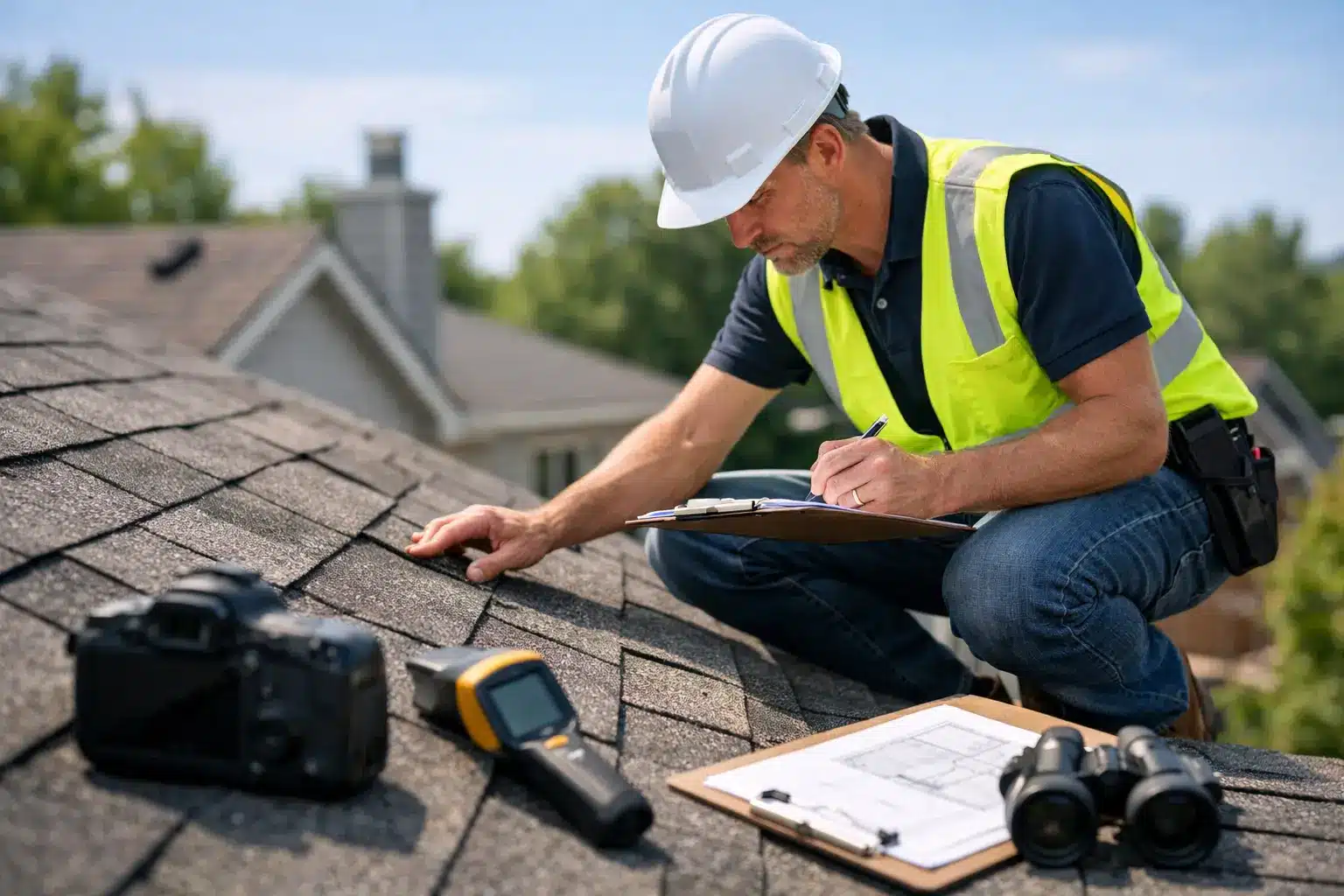
Photographs are central to the report. Each image should be clear enough to show the condition, with captions identifying the roof area and concern. Wide photos establish location, while close-ups show the damage. Interior photos may also be helpful when they document ceiling stains, wet drywall, mold-like growth, peeling paint, or active water intrusion. Interior staining alone does not prove where a leak began, but it helps connect the homeowner’s observed problem to the inspection findings.
A strong report also separates observed facts from professional opinion. For example, it may state that shingles on a particular slope are creased and lifted, that fasteners are exposed at a flashing detail, or that moisture staining is present in an attic area. It can then explain whether those conditions are consistent with wind exposure, water intrusion, long-term deterioration, or a combination of factors.
What to do before the adjuster visit
Start documenting as soon as it is safe. Take date-stamped photos from the ground of visible roof damage, fallen branches, damaged gutters, and interior leaks. Keep a simple record of when the storm occurred, when you first noticed the problem, and every step you took to limit damage. Save receipts for emergency mitigation, such as tarping or drying work.
Do not climb onto a wet, steep, or storm-damaged roof. A broken shingle can be documented by a qualified roofing professional without putting a homeowner at risk. Avoid pulling loose materials, pressure washing the roof, or making permanent repairs before the insurer has had an opportunity to inspect, unless immediate work is necessary to prevent further damage.
Most policies require homeowners to take reasonable steps to protect the property from additional loss. That may mean placing a temporary cover over an opening or arranging prompt leak control. Temporary protection is not the same as concealing the condition. Photograph the damaged area before and after emergency measures when possible, and keep all related invoices.
You should also review your policy and follow its reporting requirements. Claim deadlines, hurricane deductibles, exclusions, and documentation expectations vary. If you are unsure what your policy requires, ask your carrier or agent. A roofing contractor can document roof conditions and recommend repairs, but cannot determine coverage or interpret your policy as an insurer would.
How to read the findings without jumping to replacement
A roof inspection may reveal several issues at once. That does not automatically mean the entire roof needs to be replaced. A localized wind-damaged section, failed pipe boot, chimney flashing issue, or skylight problem can sometimes be repaired if the surrounding roofing materials remain serviceable and compatible repair materials are available.
Replacement may be the more practical recommendation when damage is widespread, the roof system is near the end of its useful life, repairs would be scattered across multiple slopes, or underlying decking and moisture damage are extensive. Matching new shingles to heavily weathered shingles can also be difficult. The right answer depends on the condition of the full roof, not only the most visible damaged spot.
Ask for an explanation of the proposed scope. A clear contractor should be able to show you the affected areas, explain why water is getting in, and describe how the repair will tie into surrounding materials. This is especially important around chimneys, skylights, vents, and roof-to-wall transitions, where surface patching may stop a drip briefly without correcting the failed flashing beneath it.
Common report problems that weaken a claim file
A one-line statement that says “storm damage found” is rarely enough to help a homeowner understand the roof condition. Reports are more useful when they identify locations, materials, observed damage, and supporting photographs. Vague estimates without a defined scope can create confusion about what work is actually needed.
Another problem is treating every roof concern as new storm damage. Florida roofs often have a mix of recent damage and long-term sun or moisture exposure. Accurate documentation is more credible than an exaggerated claim, and it gives you a sound basis for repairs even if part of the work is not covered.
Finally, do not let an insurance claim delay necessary action on an active leak. Water can travel along decking, framing, or insulation before it reaches a ceiling. What begins as a small stain can become damaged drywall, insulation, flooring, or roof decking. Prompt diagnosis and temporary protection can reduce that risk while the claim process moves forward.
Choose an inspection built on facts
For homeowners in Jacksonville Florida, Arlington, East Arlington, St. Johns Bluff, Girvin, Hidden Hills, and the Beaches, the most helpful inspection is one that follows the evidence. It should look beyond visible shingles to the flashing, penetrations, drainage details, and surrounding materials that determine whether the roof is truly watertight.
James Neill Roofing Repair provides inspection-led roofing evaluations with documented findings and photographs, so homeowners can make decisions with clear information. Whether the outcome is a focused repair, temporary storm protection, or a broader repair scope, the work should address the cause of the problem and help protect your home from the next hard rain.