

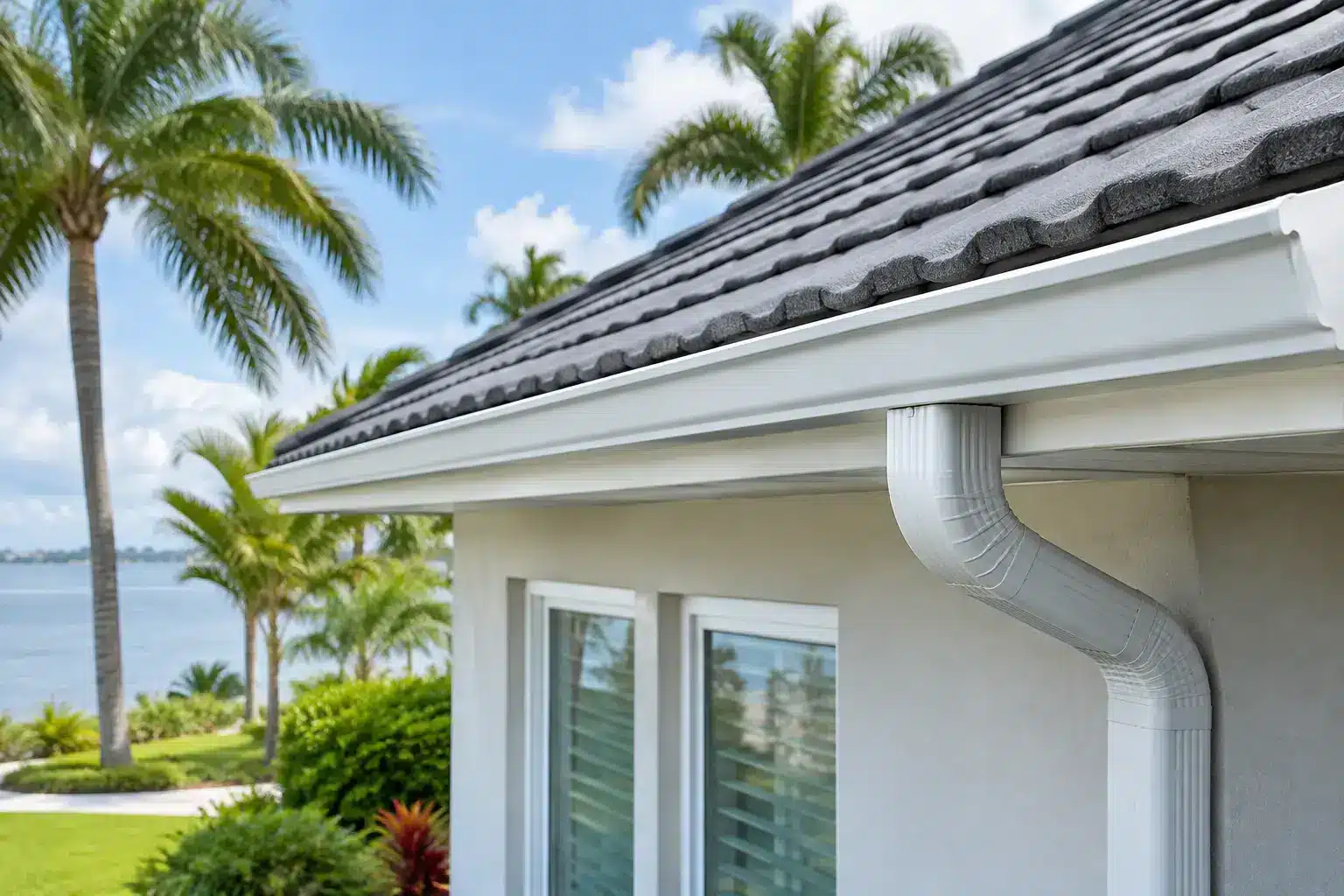

A hard Jacksonville rain can reveal a roof drainage problem in minutes. Water that should move cleanly from the roof to the gutters may instead spill behind a gutter, collect against a wall, pond on a low-slope section, or find its way beneath flashing. This Florida roof drainage guide explains what homeowners should watch for and why the visible water path is not always the true source of a leak.
Roof drainage is more than a gutter issue. It involves the slope and surface of the roof, valleys, flashing, drip edge, gutters, downspouts, roof penetrations, and the ground where water finally discharges. When one part fails, water can damage fascia, soffits, siding, ceilings, insulation, and framing long before a homeowner sees a stain indoors.
Why Florida Roof Drainage Needs Special Attention
Florida roofs must manage large volumes of water during sudden downpours, often after months of intense sun and humidity have aged sealants, shingles, coatings, and metal components. Wind-driven rain adds another challenge. Water does not always travel downward in a straight line when wind pushes it under lifted shingle edges, into a chimney transition, or around a skylight.
Coastal and near-coastal areas can also experience salt-laden moisture that speeds up corrosion on gutter fasteners, metal flashing, and roof accessories. In older Jacksonville homes, sagging fascia or deteriorated eaves may prevent gutters from holding their intended slope. A gutter can look secure from the ground while quietly pulling away at a section where the wood behind it has weakened.
The practical goal is simple: get water off the roof, into a sound collection system when one is installed, and away from the house without allowing it to back up or enter vulnerable roof details.
Florida Roof Drainage Guide: Follow the Water Path
A useful inspection begins at the top of the roof and follows the route water takes during a storm. This approach helps separate drainage failures from other conditions that can look similar, such as a worn plumbing boot or failed sealant around a roof penetration.
Roof slopes, valleys, and low areas
On a shingle roof, valleys carry runoff from two roof planes into one concentrated channel. They are high-demand areas. Missing shingles, exposed fasteners, damaged valley metal, or debris buildup can slow water and allow it to move beneath the roofing material. A leak near a valley should not be handled by simply patching the ceiling stain or applying surface sealant without inspecting the valley and nearby shingles.
Low-slope and flat roofs require a different standard of review. They are designed to drain gradually, but they should not hold standing water for extended periods after normal rainfall. Ponding water may point to a blocked drain or scupper, a sagging deck, failed coating, membrane damage, or an inadequate slope. The repair depends on the cause. Cleaning a drain may solve one problem, while a depressed area in the roof structure calls for a more involved correction.
Flashing and roof transitions
Chimneys, skylights, walls, vents, and changes in roof elevation interrupt the flow of water. These are common locations for leaks because drainage depends on correctly layered flashing, not just caulk. Water should be directed around the obstruction and back onto the roof surface.
For example, a chimney cricket may be needed behind a wider chimney to divert runoff instead of allowing it to collect against the brick or siding. A skylight can leak because of cracked glass, a failed seal, or damaged flashing at the roof connection. Those are different problems with different repairs. Careful diagnosis protects homeowners from paying for work that addresses only the symptom.
Drip edge, gutters, and fascia
At the roof edge, drip edge helps direct water into the gutter and protects the wood at the eave. If drip edge is missing, bent, improperly positioned, or buried beneath roofing material in the wrong way, water can run behind the gutter. The result may be peeling paint, rotted fascia, stained soffits, and loosened gutter brackets.
Gutters should slope gently toward their downspouts. A gutter that overflows during every major storm may be clogged, undersized for the roof area, incorrectly pitched, or receiving too much runoff at one valley. It may also have a downspout blockage. Replacing a gutter without checking the roof edge, fascia condition, and valley discharge can leave the actual problem in place.
Downspouts and ground drainage
Downspouts are the final step in roof drainage, but they should not empty water beside the foundation, porch, or Florida room. Splashing water can erode soil, saturate landscaping, stain exterior finishes, and contribute to moisture problems near the home.
Extensions or properly designed underground drainage may help, but the right solution depends on the yard grade, hardscape, local drainage patterns, and where the water can safely discharge. Water should be directed away from the structure without creating a problem for a neighboring property or a low area in the yard.
Signs Your Roof Is Not Draining Properly
Homeowners do not need to climb onto the roof to identify many drainage concerns. During a rainfall, watch from a safe location and note where water overflows, streams behind gutters, or lands against the house. After the storm, inspect the attic or upper ceilings for fresh staining, damp insulation, or a musty odor.
These conditions deserve prompt attention:
- Gutters overflowing even after they were recently cleaned
- Water running behind gutters or dripping from fascia and soffits
- Dark stains, soft wood, or peeling paint at roof edges
- Standing water on a flat or low-slope roof long after rain has stopped
- Interior stains near valleys, chimneys, skylights, exterior walls, or vent pipes
- Soil washout, pooling, or persistent wetness where downspouts discharge
A single overflow event during an extreme storm may not prove that the system has failed. Repeated overflow in ordinary heavy rain is more concerning. The same applies to a small ceiling stain: it could come from a current roof leak, but it could also be an older issue that needs confirmation before repair decisions are made.
Maintenance That Prevents Larger Repairs
Routine maintenance gives water a clear path before the next storm. Gutters and downspouts should be cleaned as needed, especially after leaf drop and before the most active rainy periods. In heavily treed neighborhoods, one cleaning per year may not be enough.
From the ground, look for loose gutter sections, missing fasteners, sagging runs, and downspouts that have separated at joints. Check that splash blocks or extensions have not shifted. Keep roof valleys clear of branches and loose debris, but avoid walking on shingles or attempting roof work without proper safety equipment.
Roof maintenance should also include a close look at flashing, vent boots, skylight details, chimney caps, ridge areas, and the condition of surrounding shingles or roof coatings. A loose chimney cap may allow water into the chimney system, while failing flashing at its base may send water into the roof structure. Both can appear as a ceiling leak, but they require different repairs.
When an Inspection Is the Better Next Step
Homeowners sometimes assume a drainage issue means they need a complete new roof. That is not always the case. A focused repair may be appropriate when the roof still has useful life and the issue is localized to damaged flashing, a blocked drainage path, deteriorated fascia, a failed flat-roof detail, or a small area of worn shingles.
On the other hand, repeated leaks in several locations, widespread shingle deterioration, extensive soft decking, or an aging flat-roof membrane may indicate a broader condition. The decision should be based on documented findings, including the source of water intrusion and the condition of materials around it.
James Neill Roofing Repair approaches drainage and leak concerns through inspection-led diagnosis, not generalized repairs. For Jacksonville-area homeowners, that means evaluating the complete water path and explaining whether the problem is at the roof surface, a penetration, flashing, gutter system, or the supporting wood behind it. As a Florida-certified roofing contractor, license CCC057937, the goal is to recommend work that protects the home without pushing unnecessary replacement.
After the next hard rain, take a few minutes to observe where the water goes. A clear runoff path today can prevent a hidden leak, damaged fascia, or costly interior repair later.